TRANSCRIPT
[ Singing in Italian ] [ Singing in Italian ] [ Singing in Italian ] [ Singing in Italian ] ♪♪ Major funding for "Great Performances" is provided by... ...and by contributions to your PBS station from viewers like you.
Thank you.
-Hello.
I'm tenor Matthew Polenzani, and I'm sitting on the set of the Café Momus, watering hole for the Bohemians of 19th-century Paris.
The café was immortalized in Giacomo Puccini's masterpiece "La Bohème" and brought to life on the stage of the Met in Franco Zeffirelli's timeless production.
This is where Mimi and Rodolfo, the opera's tragic young lovers, go on their first date on Christmas Eve in the Parisian Latin Quarter, teeming with life.
There's a reason "La Bohème" is the Met's most performed opera.
It's a classic love story accompanied by some of Puccini's greatest arias and duets.
And with today's brilliant cast of rising young stars, the soaring score seems as fresh and spontaneous as ever.
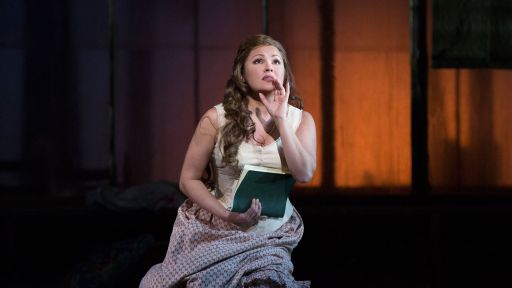
Armenian soprano Juliana Grigoryan, who just two seasons ago was in the Met's Young Artist Program, today stars as the frail seamstress Mimi.
The ardent British-Italian tenor Freddie De Tommaso is the struggling poet Rodolfo, who falls instantly in love with Mimi when she appears at his doorstep.
The on-again, off-again sweethearts Musetta and Marcello are sung by opera favorites soprano Heidi Stober and baritone Lucas Meachem.
"La Bohème" calls on the company's full forces, including a vast chorus and children's chorus, the incomparable stage crew, that incredible orchestra, and even a donkey named Wanda.
Maestro Keri-Lynn Wilson is ready to go to the pit.
Here is "La Bohème."
[ Applause ] [ Applause ] ♪♪ ♪♪ ♪♪ -[ Sings in Italian ] [ Sings in Italian ] [ Singing in Italian ] ♪♪ ♪♪ ♪♪ ♪♪ [ Singing in Italian ] [ Singing in Italian ] -[ Sings in Italian ] [ Singing in Italian ] [ Singing in Italian ] [ Sings in Italian ] [ Sings in Italian ] ♪♪ [ Pounding on door ] -[ Sings in Italian ] -[ Sings in Italian ] ♪♪ [ Sings in Italian ] ♪♪ -[ Sings in Italian ] [ Sings in Italian ] [ Laughter ] [ Singing in Italian ] [Coins rattling] [ Singing in Italian ] -[ Sings in Italian ] -[ Sings in Italian ] -[ Laughs ] -[ Sings in Italian ] [ Singing in Italian ] [ Singing in Italian ] [ Singing in Italian ] [ Singing in Italian ] [ Singing in Italian ] -[ Sings in Italian ] [ Pounding on door ] -[ Sings in Italian ] ♪♪ ♪♪ ♪♪ [ Knock on door ] -[ Sings in Italian ] -[ Sings in Italian ] -[ Sings in Italian ] ♪♪ -[ Sings in Italian ] -[ Sings in Italian ] ♪♪ ♪♪ [ Sings in Italian ] -♪ Sì ♪ [ Singing in Italian ] ♪ Sì ♪ ♪♪ ♪ Grazie ♪ [ Sings in Italian ] [ Singing in Italian ] [ Singing in Italian ] ♪♪ ♪♪ [ Gasps ] ♪♪ ♪♪ -[ Sings in Italian ] ♪♪ [ Cheers and applause ] [ Cheers and applause ] -♪ Sì ♪ [ Cheers and applause ] -[ Sings in Italian ] [ Sings in Italian ] -[ Sings in Italian ] -[ Sings in Italian ] [ Sings in Italian ] ♪♪ ♪♪ [ Singing in Italian ] ♪♪ ♪♪ ♪♪ [ Cheers and applause ] [ Indistinct conversations ] ♪♪ [ Singing in Italian ] ♪♪ [ Singing in Italian ] ♪♪ ♪♪ [ Singing in Italian ] -[ Screams ] [ Singing in Italian ] [ Singing in Italian ] [ Singing in Italian ] ♪♪ [ Vocalizing ] ♪♪ [ Singing in Italian ] ♪♪ [ Singing in Italian ] [ Singing in Italian ] [ Singing in Italian ] [ Singing in Italian ] ♪♪ [ Singing in Italian ] ♪♪ -[ Laughing ] ♪♪ [ Singing in Italian ] [ Singing in Italian ] [ Singing in Italian ] -[ Groans ] -[ Sings in Italian ] [ Singing in Italian ] -[ Sings in Italian ] ♪♪ ♪♪ [ Singing in Italian ] ♪♪ -[ Vocalizing dramatically ] -[ Sings in Italian ] [ Laughter ] [ Singing in Italian ] [ Singing in Italian ] ♪♪ ♪♪ -[ Giggles ] -[ Sings in Italian ] [ Singing in Italian ] [ Singing in Italian ] ♪♪ [ Singing in Italian ] [ Singing in Italian ] ♪♪ ♪♪ [ Singing in Italian ] ♪♪ ♪♪ ♪♪ [ Cheers and applause ] [ Cheers and applause ] [ Instruments tuning ] -Let's return to the world of "La Bohème" and Mimi and Rodolfo.
Some time has passed, and so has the first bloom of their love.
Here now is Act 3 of "La Bohème."
[ Cheers and applause ] [ Cheers and applause ] ♪♪ ♪♪ ♪♪ ♪♪ ♪♪ ♪♪ ♪♪ [ Singing in Italian ] -[ Sings in Italian ] [ Singing in Italian ] [ Laughter ] [ Singing in Italian ] [ Singing in Italian ] ♪♪ -♪ Buongiorno, buongiorno, buongiorno ♪ ♪♪ ♪♪ ♪♪ ♪♪ -[ Coughing ] ♪♪ ♪♪ [ Sings in Italian ] -[ Sings in Italian ] -♪ Grazie ♪ -[ Sings in Italian ] [ Sings in Italian ] ♪♪ ♪♪ -♪ Mimi ♪ -[ Sings in Italian ] -[ Sings in Italian ] -[ Coughing ] ♪♪ ♪♪ ♪♪ ♪♪ [ Singing in Italian ] ♪♪ ♪♪ -[ Sings in Italian ] ♪♪ [ Singing in Italian ] ♪♪ -[ Crying ] [ Coughing ] ♪♪ [ Singing in Italian ] ♪♪ -[ Laughing ] -[ Sings in Italian ] ♪♪ ♪♪ ♪♪ ♪♪ ♪♪ [ Sings in Italian ] ♪♪ ♪♪ [ Sings in Italian ] ♪♪ ♪♪ [ Applause ] [ Singing in Italian ] [ Sings in Italian ] [ Group singing in Italian ] ♪♪ [ Singing in Italian ] ♪♪ ♪♪ ♪♪ ♪♪ ♪♪ ♪♪ ♪♪ ♪♪ -[ Sings in Italian ] ♪♪ ♪♪ ♪♪ ♪♪ ♪♪ [ Applause ] [ Applause continues ] [ Applause ] [ Cheers and applause ] ♪♪ -[ Sings in Italian ] ♪♪ ♪♪ ♪♪ ♪♪ ♪♪ ♪♪ [ Singing in Italian ] ♪♪ ♪♪ ♪♪ ♪♪ ♪♪ ♪♪ ♪♪ ♪♪ [ Applause ] ♪♪ -[ Sings in Italian ] [ Singing in Italian ] [ All exclaim ] [ All shout ] ♪♪ ♪♪ ♪♪ [ Laughter ] -[ Vocalizing ] ♪♪ -[ Singing falsetto ] [ Laughter ] ♪♪ -Aah!
♪♪ ♪♪ ♪♪ -♪ Musetta ♪ -Aah!
♪♪ ♪♪ -[ Sings in Italian ] -Shh!
-[ Sings in Italian ] ♪♪ [ Singing in Italian ] ♪♪ ♪♪ -Shh.
[ Singing in Italian ] -[ Sings in Italian ] ♪♪ -[ Sings in Italian ] -[ Sings in Italian ] ♪♪ ♪♪ ♪♪ ♪♪ ♪♪ [ Applause ] -[ Sings in Italian ] ♪♪ ♪♪ ♪♪ ♪♪ ♪♪ ♪♪ ♪♪ ♪♪ ♪♪ -[ Sings in Italian ] ♪♪ -[ Sings in Italian ] -[ Coughing ] [ Music swells ] -[ Sings in Italian ] ♪♪ ♪♪ ♪♪ -[ Sings in Italian ] -[ Sings in Italian ] ♪♪ [ Mournful note plays ] ♪♪ ♪♪ [ Resounding mournful music plays ] ♪♪ -♪ Mimi ♪ ♪♪ ♪ Mimi ♪ [ Crying ] ♪♪ ♪♪ ♪♪ ♪♪ ♪♪ [ Applause ] [ Applause continues ] [ Cheers and applause ] [ Cheers and applause continue ] [ Applause continues ] [ Cheers and applause ] [ Cheers and applause ] [ Cheers and applause ] [ Cheers and applause ] [ Cheers and applause ] [ Applause continues ] [ Cheers and applause ] [ Applause continues ] [ Cheers and applause ] [ Cheers and applause continue ] [ Applause continues ] -We're done!
We're done!
-Whoo!
-Yeah!
-Yes!
-[ Laughs ] -Hey, Juliana.
-Hi.
-Fabulous.
So great.
-Thank you for that gift.
-Thank you so much.
-Right now I'm literally leaving my Cinderella era because, like, everything in here feels like a fairy tale.
-Yeah.
This whole experience or you mean Mimi?
-The whole experience with such a great team, such a great cast in this wonderful historical building and actually, uh, one, like, one of those, like, highlights that I want to mention, like this costume.
-Yeah.
-Once we were, like, dressing up with my dresser, Leila, and we found one label which says, like, this costume was worn in '96-'97 season, which means, like, that it's older than me.
-Yeah.
Was this like a "pinch me" moment?
-It's a huge honor.
-Yeah.
-It's a huge honor.
Yes.
That's a "pinch me" moment.
And right now I'm, like, feeling so special because I'm not wearing just a costume.
-Yeah.
-I'm wearing the history of the Met, and it's -- it's unbelievable.
-Well, tell me a little bit about "D'onde lieta."
What are you feeling in this moment?
What are you trying to convey?
What's your emotional state while you're singing this?
-My emotions in here are -- You know, I'm singing like a breakup aria, but in deep in my soul, of course I don't want to break up.
Actually, she doesn't know the real reason why Rodolfo is acting like that.
She thinks that he's just, like, jealous and blah, blah, but actually, she's sick and she doesn't realize it.
So, it's very heartbreaking but still, it's wonderful that they decide to stay together.
-Yeah.
-Yeah.
It's written so fantastically that it just helps.
And you don't need to do much.
-Yeah.
-Here in this opera, less is more.
-No, I mean, Puccini's heart is right out there for everyone to see.
You guys are bringing that so well to life.
Talk to me about "Sono andati."
-The last aria.
Actually, last aria is my favorite one because she sings what she wants to tell.
She sings what she feels inside of her.
The first aria was like she's -- it was introducing herself.
But the fourth act, and, you know, I don't try.
As I said, less is more.
I don't try to overplay because there is no need.
-No.
-Because the real heartbreak comes from, uh, Rodolfo's reaction.
-Oh, yeah.
-And especially from Freddie's reaction.
-Yeah.
-I'm like this.
I'm laying like that and I was like, "Oh, no, what are you doing to me?"
And I wanted, like, literally to cry.
-You're right.
Simpler is always better.
Juliana, thank you so much for speaking with me.
-Thank you.
Bye!
-Freddie.
Hi.
Bravo.
-Hello.
-You sound amazing.
-Thank you.
-It's great to hear you singing it.
-I'm having a nice time.
-Alright.
Talk to me about Rodolfo a little bit.
How is it feeling the first time you're singing this on this stage?
-Oh, it's amazing, honestly.
Obviously, because it's such an iconic production.
Basically everybody has done it.
And so getting to, you know, step into those shoes, as it were, it's really, really exciting.
-The Met is one of the -- is maybe the world's largest opera house.
Do you have to make any sort of vocal adjustments when you're singing here?
-I try not to, but obviously, when you stand out there and you look and see however many thousands of seats, you kind of think, "Oh, okay, big space, let's go."
But no, try to sing just normally.
-No, you have it completely right, man, because the acoustic here is perfect.
-It is.
It's good.
-Yeah.
-It's surprisingly good for such a big, big space.
-Yeah.
The last time the Met's HD audiences saw you, it was last season as the young revolutionary Cavaradossi in Puccini's "Tosca."
-Yeah.
-Which was also your Met debut.
-Yeah.
-How would you compare the vocal demands of Rodolfo versus Cavaradossi?
-Um, Rodolfo is kind of a "lighter" part, generally, I would say.
It's a lot more chatty, I would say.
A lot of the singing is kind of, yes, it has that chatty quality.
There's more scope for playfulness as well I would say with Rodolfo, which I really like.
You know, it gives me the feeling of, uh, of being back in my, uh, back in my school days and kind of, you know -- -Oh, yeah.
-It's got that bantery feeling.
-No, it's something I missed out on.
Like, when I left college, I didn't get to live with my roommates, my college buddies.
-Yeah, yeah.
-Alright, so let's talk about "Bohème."
It's arguably the world's most popular opera.
-Yeah.
-What are your thoughts on why it still hits home for so many people?
-Uh, I mean, you know, there's the whole aspect of it being a verismo opera, so veristic operas touching on stories which are more relatable to the everyday person.
-Sure.
-And I think -- So it really speaks to them.
Ultimately, it's a love story, and everyone can relate to that in some way, shape or form.
-Yeah.
Plus the music.
Come on.
-Yeah, the music.
Exactly.
He was a master.
He was a master.
And he really knew how to tug on the heartstrings.
-Yeah.
-And it speaks to people.
-You think you're going to keep this part around for a little while?
-Yeah, yeah.
Definitely.
-Is this something you want to keep going with?
-Yeah.
I mean, it's so beautiful, isn't it?
-Oh, yeah.
-I don't think I'll ever let it go completely.
-Oh.
I mean, it's hard to imagine actually even have to -- it hasn't been that -- it's been maybe 10 years for me, but I mean, I said it earlier.
I can't believe how much I was smiling watching the end of Act 2.
Anyway.
So, let's talk about some of the other things you've got coming up in the future.
-Yeah.
-You have good ideas for roles in future years?
-Yeah, you know, I'm just kind of going step by step through into the more dramatic or kind of lirico spinto parts of Verdi and of Puccini and the other verismo composers.
-Sure.
-So, yeah, just, you know, step by step.
Kind of one or two debuts per year.
-Yeah.
-And yeah, just enjoying the -- enjoying the journey.
-Enjoying the ride.
Yeah.
-Exactly.
Yeah.
-Exactly.
Okay, we're going to talk about the end now.
I always struggle with the end.
Like, the first time, walking out for a bow at the end, I'm like -- I'm kind of not ready.
I mean, do you ever have trouble not getting choked up, like, while you're on the stage because she's -- -Oh, completely.
-Yeah.
-Every time, I'm more crying than singing at the end.
I find it very, very hard to deal with, so.
-Well, good luck out there.
-Thanks very much.
-Enjoy it.
-Freddie, thanks for talking to me.
In bocca al lupo for the rest.
-Thank you.
Crepi.
-And I'll see you again.
Take care.
Ciao.
-Cheers.
Thank you.
-Man, you know, I don't know how many times I've sung this opera over the years, but I'm standing here on the side, and I'm listening, and I just have a smile on my face.
I mean, there's not a note in it that you could change.
There's not a moment that you would want to modify.
-Yeah.
-No.
-It's like utter perfection, right?
-That's Puccini, man.
-That's Puccini.
-I mean, how does it feel to be a part of this, like, extravaganza as imagined by director Franco Zeffirelli?
Heidi?
-This production is unbelievable, iconic.
I mean, I hope it never, never, never goes away.
It's such a pleasure and honor to be a part of it.
-Yeah.
This famous production veers from the intimacy of the garret in Act 1 to one of the biggest crowd scenes in all of opera.
What's it like sharing the stage with Wanda, the donkey, and Lora, the horse?
-Well, it's selfie-rific because all you do is want to take pictures with the donkey and the horse.
I mean, I love taking pictures with Heidi too.
-Yeah.
[ Laughs ] That's being a good colleague.
-Actually you really have to watch out.
When they're coming through, they are coming through.
You just must move.
It is just part of the scene.
You have to get out of the way.
-Yeah.
-I mean, you ride in on it.
-I do.
-What's it feel like in the carriage?
-You know, you hope that the horse will stop so that you can get off the carriage.
[ Laughter ] -Well, let's talk a little bit about your relationship, which is certainly tempestuous, let's say.
What do you think Puccini had in mind when he created you two?
-Oh, I think this is the truest love between the two of them.
-Really?
-Yes.
-More true than Mimi and Rodolfo?
-I'm not saying that that isn't -- doesn't have weight as well.
But I think they have all the layers and they can't live without each other.
They're really the yin to each other's yangs and it's true youthful romance.
Because, I mean, I remember back in the day, there was tempestuousness in some of my previous romantic endeavors.
But, like, that's what it is, though.
It's like -- it's not -- it's so honest in that way that we really do kind of love and hate each other at the same time, and that just goes back and forth and that leads to the attraction between us.
-Ah, yeah.
-It's just part of it.
-So, we just heard "Quando me'n vo'," Musetta's waltz, one of the most famous, time-stopping arias in all of opera.
How do you prepare for that little moment?
-Oh, my goodness.
I mean, I feel like I've been studying this aria for as long as I can remember, and for me, the thing that I always think about any time I get to sing Musetta now is singing it with Henry in my tummy back in 2012 in Houston.
-Oh, that's a great memory.
-Yeah, yeah, yeah.
So that's very special, and he was here and saw two of the performances in this run.
-You nailed it anyway.
-Thank you.
-Lucas, in the first act, we saw the camaraderie of the four young Bohemians.
In a short rehearsal period, how hard is it to create the chemistry that makes it look like you've been friends for years?
-Well, Puccini really wrote it into the part, you know?
I mean, you have -- you have an author, you have a poet, you have an artist, and you have a musician.
So it's like you've got every level of art sort of maintained in one small garret in Paris.
And it's all that love for art, that love for what it is that we just did out here, what you're watching at home, you know?
-Creating.
-It's creative.
Creative.
-Yeah.
So that's what -- -Hey, guys.
Thank you so much for speaking with me.
-It's so nice to see you, Matthew.
-Good to see you too.
As we just saw Act 2 has all the Met's choral forces on stage, from children to adults.
Overseeing their vocal output is the Met's renowned chorus director, Tilman Michael.
He recently shared his thoughts about preparing for this spectacular moment.
[ Singing in Italian ] [ Singing in Italian ] -[ Vocalizing ] [ Singing in Italian ] ♪♪ ♪♪ [ Singing in Italian ] ♪♪ [ Singing in Italian ] [ Applause ] -Puccini's score for "La Bohème" offers an extraordinary emotional and dynamic range.
We recently sat down with Maestro Keri-Lynn Wilson to take us through the musical landscape of Puccini's extraordinary score.
-I just love conducting "La Bohème."
It's an opera that is filled of extremes -- of joy, of laughter, of humor, of joie de vivre, contrasted with anger, jealousy, heartbreak, and of course suffering and pain.
Puccini was a genius orchestrator.
He has a palette of orchestral color that always reflect the mood and the atmosphere.
In the first bar, it's one big, bombastic, in-unison motif of the orchestra.
Da-da-da da!
♪♪ He's created this joy and this energy, this rhythm, the pulsating in the orchestra.
And then he has the men almost feeling like they're just spontaneously saying something on stage.
-[ Sings in Italian ] -These characters are so realistic and just enjoying life in this first scene.
So it sets the tone for Paris in the 1830s that is the optimistic view of life, the romantic, bohemian life.
So, after this buoyant first scene, suddenly it comes to absolute silence and we hear... [ Knocks on armrest ] [ Knock on door ] ...the famous knock of Mimi behind the door.
And just softly, the violins play this pedal of an "A."
[ Soft music playing ] So we're suddenly switched into a whole different mood of suspense, of innocence, of eventual love.
[ Singing in Italian ] And the music couldn't be more romantic and expressive.
Very simple melodies, but lush orchestration.
He uses every instrument that highlight the words, the poetry.
It is a symphonic poem that leaves us all in this euphoric state of romance and love.
Then we come to the pièce de résistance in Puccini's opera, the Act 2 scene, which Zeffirelli makes into a world of grandeur.
We not only have orchestra, we have a double chorus, children's chorus, we have actors, we have dancers on stage.
It's Christmas Eve, so we feel the joy on stage.
It's the most over-the-top, fantastic, grand celebration of life right in front of our eyes.
[ Singing in Italian ] The third act is perhaps the most heart-wrenching.
We're transported to a mood of much more internal suffering, of vulnerability.
He goes into a very slow passage of just atmospheric music.
It's the flutes, the harp.
They're playing these staccato pianissimo notes, which reflect the snow, which this production is famous for.
We feel the chill on stage of the winter atmosphere.
It's slow, it's brooding orchestral string accompaniment.
We may feel that the mood has really turned.
It's faded from joy into something much more disturbing, that Mimi is genuinely dying, but she's dying in her heart as well, from Rodolfo's jealousy, and it's too difficult to live with him.
So we're seeing relationships now, and the reality of what sometimes is inevitable, from euphoric love to pain and heartbreak.
So as we head into Act 4, we are so emotionally attached to these characters.
We see their suffering.
We see their joy.
And we really feel like this story is no longer a story.
We feel like we are experiencing life with them, and that is the beauty of it.
[ Singing in Italian ] ♪♪